Friday, August 9, 2013

California Gold: A New Englander’s Pepperwood Journey

By Carey Lang, Pepperwood Summer Intern


Less than one week into my Pepperwood internship experience, Lisa and I road-tripped to the California Academy of Sciences to meet with a handful of scientists and researchers and discuss the crux of my internship project up at Pepperwood this summer. As we were driving down the freeway (at first I wrote “highway” but I changed it so I would sound more west coast…), she asked me what I thought of the rolling golden hills of Northern California. I squinted out the window, trying to figure out what she was talking about. Everything just looked kind of brown to me. Brown and dry.

Of course, as I told Lisa, I meant that in the most observational and scientific way possible. There’s nothing wrong with brown and dry, but when I left my home in western Massachusetts, the woods around my house were saturated with emerald and jade and everything was alive and pulsing with early summer energy. I know that green and wet do happen here; I’ve been told I just need to wait until the winter. But having never been to the west coast before, I was experiencing a little bit of a landscape identity crisis.

Now I’ve been here for six weeks and have eaten breakfast with a herd of deer munching on the grass less than two feet away from me. I’ve cantered through the field below Roller Coaster Ridge on Simba, one of the horses that lives on the preserve. From the picnic table on Three Tree Hill I’ve watched a fireworks show over Windsor to my left while a lightning storm flickered through the sky to my right. And I celebrated my 21st birthday exactly as a 21st birthday should be celebrated, with my coworkers who have become my friends. I’ve also had bats land on my face while I was sleeping. I’ve shared my house, my shower and at one point my coffeemaker with 300 roommates -- all of them tiny cockroaches. I’ve been jolted from a deep sleep by an apocalyptic thunderstorm shaking the walls of my room at 3 AM and I’ve discovered that one person cannot consume enough Annie’s Mac and Cheese to make purchasing a pack of 12 boxes a good decision.

I’ve also been working 8:30 to 5, five days a week at the Dwight Center. A lot of the time I’m working with data -- both collecting it and then crunching the numbers in Excel. However, when I’m not out in the field or sitting on my laptop, I’m hanging out with the coolest group of 13-18 year-old interns who are participating in Pepperwood’s TeenNat program. I’m working shoulder to shoulder with staff and I do have the official Pepperwood name tag, but because I’m also an intern at the preserve myself (albeit of a slightly different flavor), I think I lend a different perspective to the program. None of us are getting paid, we’re all still in school, and we don’t really have a clue as to what we’re eventually going to end up doing with our lives. I do have a little bit of experience with outdoor education, and I’ve been continually impressed with how intelligent, perceptive and motivated our TeenNat interns are, and how seriously they’re taking both their work and their play at the preserve.

The coolest thing I’ve gained from TeenNat is that up until this point, I’d never really considered a real career as an educator, but the other day I found myself browsing through my college’s course catalogue looking for education classes. I’ve really enjoyed interacting with kids who love to learn as much as I do, and I’ve even impressed myself with the things I’ve been able to teach them. The other day I just started rambling about the different types of lichen that we could observe on the preserve, which was something I’d learned about a few weeks ago while out doing fieldwork. As I pointed something out to the TeenNatters, I suddenly realized that they had all gone silent and were staring at me, listening intently. The best part, however, is that I actually knew what I was talking about. While I’m nowhere near as skilled as the fantastic education staff at Pepperwood, TeenNat has exposed me to a whole new side of myself I’m eager to explore.

I’m starting to see the gold in the Californian mountains. 


Carey Lang will return to Mount Holyoke College in South Hadley, Massachusetts this fall for her senior year. Her summer internship at Pepperwood has involved assisting with the new TeenNat internship program and working with Pepperwood researchers to streamline data collection and management for our many on-site projects. We are very grateful for her all she has done!

Thursday, July 18, 2013

Creating a Beautiful Demonstration Garden

By Sandi Funke, Education Director

Volunteers take a break to pose during a Volunteer Workday
In the spring of 2013 a dedicated group of staff and volunteers finished installing stage one of Pepperwood’s Demonstration Garden. Groups such as our TeenNat internship program are already out wandering the golden pathways, exploring the plants, and observing the newly arrived visiting pollinators. The attractive undulating sitting area situated under an embracing oak is luring groups in for receptions, small meetings, or classes just grabbing a snack after a long expedition. The entire area is so well suited to the site it is becoming very hard to remember the Dwight Center without it.


Michael (left) and volunteers during construction of raised beds
However, designing and installing the garden was no small feat. This multi-year effort would not have happened without the hard work of Michael Golas. Michael is a Pepperwood steward and owner of Michael Golas Landscape Design. Besides lending his considerable talents through the design and installation of the project, he donated the in-kind services of his hard working crew on several occasions. We recently had a chance to interview Michael to hear directly from him how the project unfolded.

PW-How did you get started helping with Pepperwood’s Demonstration Garden? What was your role?

View of the garden from benches in the shade of an oak tree

“It was an idea that came to me while attending our final Bio 85 class in the late spring of 2010. Sitting on picnic tables under two magnificent Coast Live Oaks on that warm afternoon made me think of others who would enjoy having the same opportunity in a more developed setting. The picnic tables were replaced with curved benches stepped into the natural slope under the arching branches. The demonstration garden idea was shared and further developed with staff input, and a plan was conceived with the help of landscape architect Michael Cook. Construction began in fall of 2011 with the anticipated grant funding. I was asked and agreed to lead the volunteers and fellow staff through construction.”

PW-Why do you feel native plants are important to include in gardens?

Photograph of some of the plants in mid-July 2013
“Nature's diversity can be best experienced at one's own pace when a permanent location is set up for that learning. Native plants are often overlooked except those of exception that boast relative size, brilliance, and numbers that make them more distinct. We're flooded with plant introductions from around the world given the climate we in Sonoma County and California enjoy. Native plants have taken a backstage given the choices offered and, by examples presented in our garden here, we hope to highlight the important role each have to play in any permanent garden or the plant community in which they abide.”

PW-What led you to choose the plants that you did?

“Choosing nearly all native plants with most from selections collected locally, we again want to highlight the diversity and beauty that comes with our local flora for all to experience.”

PW-Now that the garden has been installed and has had a while to grow, is there anything that is surprising to you?

Volunteers creating handicap-friendly walkways through the garden
“The biggest surprise would be how well the garden has been received by visitors, volunteers and by staff. Most offered encouragement and many came to help but their reaction to seeing it has been pure joy. Second to that, the speed at which some of the selections have taken to their new home has us evaluating what can and should be included in the next round of planting.”

PW-What resources would you recommend if someone is thinking about including native plants in their home garden?

“California Flora in Fulton is our local source for material and boundless plant lore. The website offers detailed cultural information on each species with footnotes on related reading.”


Pepperwood’s Demonstration Garden is open and used in Pepperwood classes and programs, visiting classes, rental groups, during open houses, and during membership events. For more information about Pepperwood or to become a member visit our website.

Wednesday, July 10, 2013

Learning More About Our Wild Neighbors

By Tom Greco

A young deer photographed by
a Pepperwood wildlife camera
Every year, thousands of animals are killed on roadways in Northern California, a problem that impacts both wildlife populations and our safety on the road. In 2010 alone, California Highway Patrol reported over 1,800 wildlife-vehicle collisions state-wide. As residential and agricultural development continues to expand, so too will the habitat conversion pressures facing our region’s wild inhabitants. Some impacts from human activity are obvious – we have all seen dead deer or raccoon on the side of the road – but the stealthy nature of animals like black bears and mountain lions keeps most of their habitats a mystery. Through new advances in technology and a team of dedicated volunteers, Pepperwood is now gaining insight into the life cycles and movement patterns of our wild neighbors.
A bobcat photographed by a Pepperwood wildlife camera
Last summer Pepperwood installed 20 motion-activated cameras around our preserve, becoming the first location in Northern California to utilize the internationally recognized Wildlife Picture Index (WPI) system. This Wildlife Conservation Society method for analyzing wildlife will allow us to begin accurately recording what kinds of animals are present on the preserve, how and when they are using the land as habitat, and other valuable data. Unless we establish such a baseline for the health of our wildlife, we won’t know how populations are changing over time – and whether it is due to our management practices, impacts on habitat corridors, changing climate, or a range of other factors.

A pair of foxes photographed by a Pepperwood wildlife camera
Pepperwood works with wildlife biologist Dr. Sue Townsend to establish protocols and trainings we are applying here at the preserve to provide a model for other open spaces to begin implementing similar monitoring programs region-wide. This summer, Pepperwood worked with our partners at Audubon Canyon Ranch’s Mayacamas Mountain Sanctuary and Modini Ranch to install a second camera grid in our local wildlife corridor. These 21 new cameras are located about 20 miles north of our preserve. Given their close proximity, this expansion of our WPI project will be particularly useful for detecting potential differences in populations between sites as well as observing species migration patterns. In the future, Pepperwood aims to deploy a smaller set of cameras between the two larger sites so we can begin to see which specific routes animals choose to get from one location to the other.

"Critical Linkages" map developed by
the Conservation Lands Network
The Conservations Lands Network, a five-year science-based study with input from 125 organizations, produced a “Critical Linkages” map indicating the pieces of land most likely to be used by wildlife as they move between larger open spaces like state parks and other preserves. With the addition of more camera sites in surrounding areas, the data Pepperwood collects will help evaluate these predictions and help land trusts and other conservation organizations prioritize the acquisition of lands most beneficial to wildlife. By creating “wildlife corridors” of protected lands, we can reduce the impacts of human activity on our wild residents and give them the space they need to thrive.


Stay tuned for more updates about our Wildlife Picture Index project - Like us on Facebook to see the latest photos!

Thursday, June 6, 2013

Take Two Hikes and Call Me in the Morning

Review of Park Prescriptions: Profiles and Resources for Good Health from the Great Outdoors

By Sandi Funke, Pepperwood Education Director

Children hiking the preserve at our 2012
Budding Biologists Summer Camp
With obesity levels in the United States at all time highs, some in the medical field are beginning to think beyond treatment of disease towards promoting prevention. In Sonoma County health providers including St. Joseph Health Center , Kaiser Permanente, Alliance Health Center, Sonoma Indian Health Project  and county health services have come together to establish Sonoma Health Action. This collaborative seeks to create a healthier community through collective action. Health Action wants Sonoma to be the healthiest county in California and to this end one of the group’s goals is that residents are physically active. The collaborative has initiated the county-wide iWalk project. This initiative links residents with organized walking events and walking groups all over the county, including hikes at parks and preserves such as Pepperwood.

Pepperwood Stewards, Staff, and family members
hiking Red Hill near Jenner, CA last summer
This burgeoning local connection between healthcare providers and outdoor providers is not just happening here. The Institute for the Golden Gate in collaboration with the Golden Gate National Parks Conservancy has produced the report Park Prescriptions: Profiles and Resources for Good Health from the Great Outdoors. This fascinating report describes in clear concise non-academic language, 12 programs created by medical, public health, and park communities from across the country that aim to increase physical activity to improve health.  The report provides an introductory section that describes the way the study was conducted as well key findings that were found throughout the 12 programs.

The case studies describe each program and include helpful visuals and examples of work products.  They also have links to related literature. The Children and Nature Initiative is one of the programs described and is run by the National Environmental Education Foundation. This program holds train-the-trainer workshops to educate pediatric healthcare providers about prescribing outdoor activities to children. They even have bilingual prescription pads! This program works with specific sites that help “fill” the prescription. Similarly, the Prescription Trails New Mexico program aims to identify walking venues that are safe and accessible to patients. The program also provides prescription pads as well as trail maps and online searchable maps. Another program in New Mexico the Step into Cuba Alliance brought a large medical foundation together with partners in the forest service and national park service. Results of the alliance have been new and redesigned trails parks and trails aimed to provide the public with safe places to exercise.

Participants at a recent class hike towards Redwood Canyon
Photo by Gerald & Buff Corsi, Focus on Nature, Inc.
Several case studies were programs driven by parks and included projects close to home. SeeChange Health Insurance has partnered with California State parks to provide park information to clients and reimburse park membership fees. The Golden Gate Community Trailhead Project highlighted a partnership between the local YMCA, the Golden Gate National Recreation Area, and Golden Gate National Parks Conservancy. Signage was placed outside the YUMCA that highlighted local hike routes. YMCA staff was trained on walking/ hiking routes and the group established a hiking club.

If you’re interested in parks, healthcare, or public policy the report is a great resource. Doctors would especially find it intriguing! For more information check out the Parks Conservancy website or click here to download the report. 

Thursday, May 16, 2013

Conservation of the Western Pond Turtle

By Danielle Olivera, Pepperwood Volunteer

Western Pond Turtles enjoying their favorite log at Turtle Pond.
The white stick to the left is used to measure depth.
January: Note how close the water is to the two trees in the back left.
That little white line on the right is the top of the depth gauge.
When I was a little kid, I loved playing with tadpoles and turtles. Many years later, turtles are still high on my list of interesting animals, though now I know a lot more about them. Our research at Pepperwood Preserve has been focused on the Western Pond Turtle (Actinemys marmorata), the only native freshwater turtle in California. Unfortunately, this hard-shelled reptile has faced many challenges in the past few decades, including non-native species introductions, habitat fragmentation and human disturbance. Since then, their numbers have decreased dramatically, putting them on the International Union for Conservation of Nature (ICUN)’s List of Threatened Species in California.

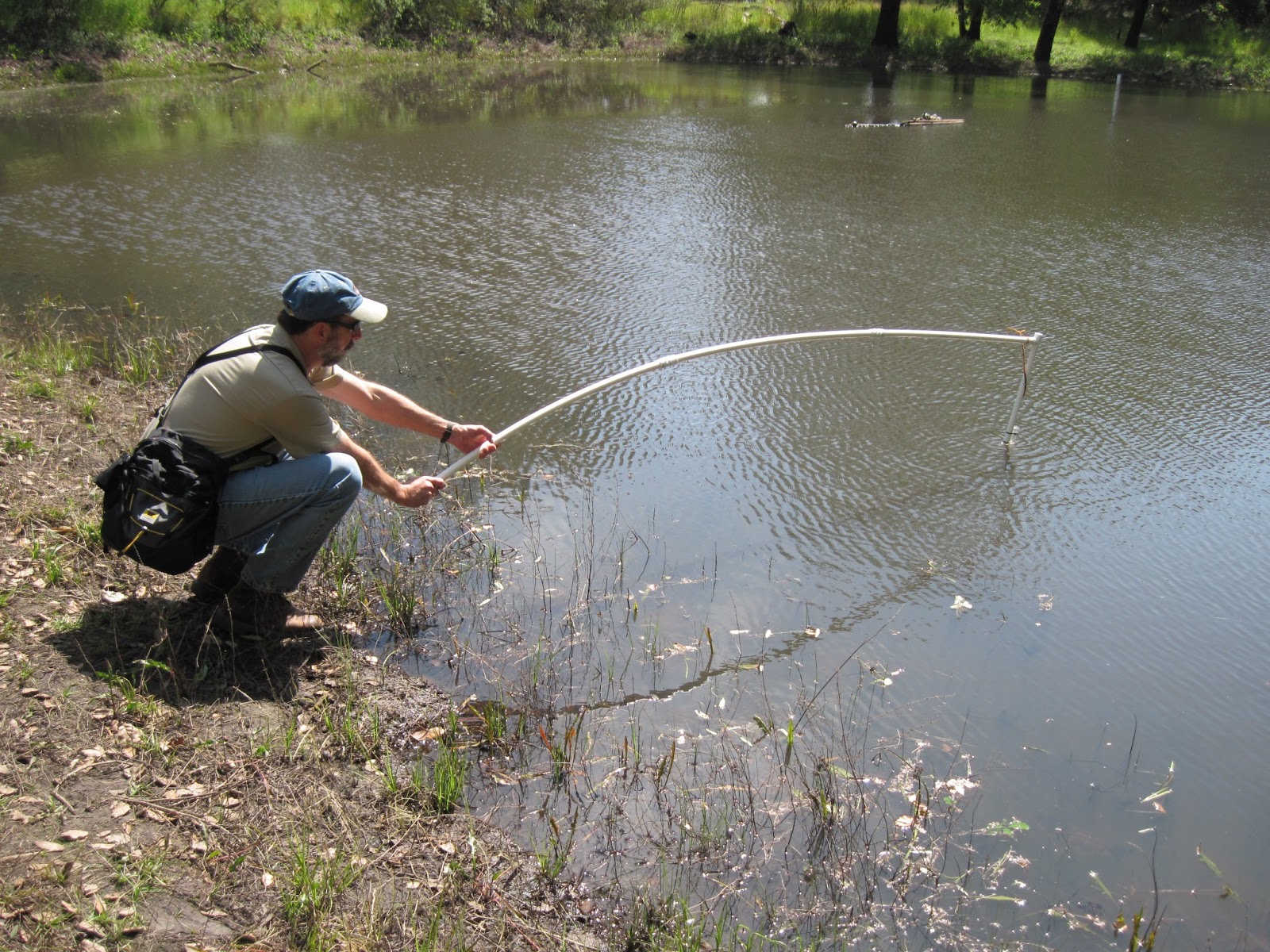
Every other week, our team of three (Pepperwood Stewards Carrie Mammoser, Lloyd Cook, and myself) hikes out to Turtle Pond, where we work to monitor the health of the pond and surrounding habitat, which has a direct impact on the turtles themselves. Since this species of turtle is on a decline, we decided to figure out what features constitute their ideal habitat. One of the key factors we’d like to determine is if human and non-native animal disturbances were negatively affecting the population at the pond.

May: So much change in just four months! By the end of the
summer, almost all of the water will probably be gone.
Each visit involves counting the number of turtles present, the types and number of all other plant and animal species present, the temperature of the air and water, wind, water height from the bottom of the pond, pH, nitrite and nitrate levels of the pond. All of these factors can affect the survival and reproduction rates of the Western Pond Turtle.

Steward Lloyd Cook taking measurements in May 2012.
While we spend most of our time observing the turtles and recording water quality, we also keep track of the other types of animals present and how those numbers fluctuate over the year. The turtles are shy and tend to jump off of their log into the water when we begin taking measurements. We’ve found that Sierran Treefrogs, California Newts, garter snakes and various fungi species are also present when there is water in the pond.

Though we only have one year of data, it’s exciting to see the monitoring project come together. It’s too early to draw any conclusions, but we can provide a couple examples of our measurements. Nitrate levels, for example, have remained constant throughout the year. The pond’s pH has also held steady at 5.5 over the course of the year. Water levels vary seasonally and can change drastically depending on rainfall – see the graph to the lower right for an illustration.

We look forward to collecting a second year’s worth of data so we can begin to compare how Turtle Pond and its community of Western Pond Turtles is changing over time.

Wednesday, May 8, 2013

Let's Go Camping: A Brief History

Enjoying the view at the 2012 Pepperwood summer camp

By Sandi Funke, Education Director

Going camping. Day camp. For those of us that had the privilege as young children of “going to camp” for the first time it felt so new! Like we were blazing a trail. Yet, organized camping in the United States and, in particular, here at Pepperwood, is not new. It originated in a drive to reconnect with the land in response to the growing industrialization of the country. Camping now, is also a way for youth to develop skills and abilities and importantly, learn more about themselves and what they are capable of.

A Brief History of Organized Camping in the US
According to the American Camping Association, the Gunnery Camp, located in Connecticut, was considered the first organized American camp. Mr. and Mrs. Gunn operated a school for boys. In 1861, they took the whole school on a two-week camping trip. The students spent their time boating, fishing, and trapping. The trip was so wonderful the Gunns continued the tradition for twelve years. Though boys got a small head start the girls weren't very far behind. 

In 1874 the Philadelphia chapter of the YWCA (Young Women’s Christian Association) founded the organization's first camp. This vacation house was for "tired young women wearing out their lives in an almost endless drudgery for wages that admit no thought of rest or recreation." The first YWCA camp was in New Jersey, and was called Sea Rest. 

After the turn of the century, camping was really catching own. In 1910, the Boy Scouts of America was founded as was Camp Fire Girls now known as Camp Fire USA. In 1919 the first Girl Scout camp was set up with the organization setting out to charter additional camps the next year. Camping continued to grow in popularity in the first half of the twentieth century and by the 1950’s the idea of “Day Camp” also gained popularity.

Budding Biologists explore one of Pepperwood's oak woodlands
Pepperwood and Camping
Pepperwood has a history with camping as well. Kenneth Bechtel, who owned Pepperwood for over 40 years, loved the outdoors. Bechtel served as president of the Boys Scouts of America from 1956–1959. While the Bechtel’s owned Pepperwood Ranch, the site served as destination for his and other families. The ranch house, now known as the Bechtel House, served as headquarters. Folks liked to come up to hike, ride horses, cut down Christmas trees, and even have fun driving the jeep!

We continue this legacy through family overnights we offer. Several times a year families can join our Preserve Manager Michael Gillogly, and children’s music teacher and composer Ginger Parish for songs, hiking and a great family camping experience! We also offer a two- week summer day camp Budding Biologists. Campers get to explore the various habitats of Pepperwood while recording their reflections in nature journals. To learn more about our programs visit the events section of our website! Happy camping!

Wednesday, May 1, 2013

Understanding Pepperwood's Mushrooms

By Prahlada Papper, Pepperwood Steward


Helvella lacunosa
The kind of warm, dry weather we’ve seen throughout inland Sonoma County this past winter isn’t usually associated with mushroom foraging, but research on mushrooms (a.k.a. “foraging for data”) continues regardless. In order to document the effects of climate on mushroom fruiting, we need to do surveys during the dry seasons as well as the rainy ones. All that data is equally valuable to a complete picture of fungal ecology.

In fact, though, several groups of mushrooms continued to be surprisingly abundant at Pepperwood throughout January and February even with less than 5cm of accumulated rainfall, including elf saddles like the Helvella lacunosa seen in the picture to the right. That one is growing in a redwood grove, but another species, Helvella maculata, has also been common under Douglas-fir along with several species of Inocybe while live oak dominated forests have been mostly devoid of mushrooms.

Inocybe
Understanding patterns like these—of when and where mushrooms appear—is the goal of a study recently revived here at Pepperwood using existing plots that had been sitting ignored and nearly forgotten for almost 15 years. Between 1996 and 1999, David Melloy, a graduate student at Sonoma State University, conducted regular surveys of mushroom diversity on the preserve using the same plots that we were surprisingly still able to re-locate after all these years. Several of those original plots were re-flagged and a few new ones were established in order to continue David’s work of studying the fungal diversity in Pepperwood’s forests and help clarify how localized climate, soils, and vegetation affect that diversity across a varied terrain and through both long and short spans of time.

From the wet and drippy Fall, to this dry and warm Winter, and now into the late Spring that we can only hope will bring rains again, our team has gathered and identified mushrooms from the plots and measured the trees surrounding them to put together spatial maps of each plot.

Combined with regularly collected data on temperature, humidity, and soil moisture, this study can help us answer basic questions about forest ecology and climate change. The appearance of mushrooms is being used as a token of the many organism-organism and organism-environment interactions that create an ecosystem.

Mycelium seen in a soil cross-section
Fungi spend most of their lives as networks of microscopic filaments in the duff layer or within the wood of fallen logs where they are among the primary decomposers of dead plant material. Or in some cases fungi form symbiotic mycorrhizal relationships with trees and plants in which a fungus helps supply water and nutrients to the plant while extracting the carbohydrates it needs to survive from the plant’s root system. At some point, environmental cues that are still not completely understood—but certainly include temperature, moisture and nutrient availability—can prompt that nondescript subsurface tangle of fungal cells to begin the fruiting process, leading to an above-ground mushroom. So fungi, and in particular their mushrooms, are uniquely suited to making many obscure environmental processes and patterns more evident. They may even be a key indicator of changing climate from year to year.
Hygrocybe

This particular mushroom study at Pepperwood Preserve will hopefully continue on for many years, generating a large enough batch of data that the more complex and long-term patterns behind the fruiting of the different mushrooms can begin to emerge from the background noise of a dynamic forest system.

This mushroom study is among the growing group of long-term monitoring projects at Pepperwood open to citizen scientist volunteers. Experience in ecological research is not necessarily required.  If you’d like to help on any aspect of the study—from fieldwork collecting mushrooms or surveying trees to lab work preparing soil samples or preserving voucher specimens—contact Pepperwood staff to be added to the project’s mailing or volunteer list. Work continues, rain or shine!