Monday, April 20, 2015

Exploring Badgers with Dr. Jessie Quinn

We're excited to host Dr. Jessie Quinn of Great Ecology for our next Discover Nature lecture on Badgers!


American badger (Taxidea taxus), photo by 
Oregon Department of Fish and Wildlife
Digging Dynamos: 
Badgers of Coastal California
Friday, May 1st, 2015 
7pm lecture, no reservations necessary
Free, with donations greatly appreciated
Click here for more info.

Learn about the mysterious and charismatic American Badger as Dr. Quinn shares her 4 years of work with UC Davis studying badger ecology and population distribution across California. 

We hope you'll join us for her lecture on May 1st! 

In the meantime, brush up on your badger knowledge by reading our latest blog post below. Responses by Dr. Jessie Quinn.
 
European badger (Meles meles)
1) What is your background and how did you get involved studying badgers?  

My background is in wildlife ecology, which actually stemmed from a love of the outdoors, and from a hobby of birdwatching I developed as an undergraduate at UC Santa Barbara. I spent several years after college working on bird projects for various agencies. I eventually decided to pursue graduate studies at UC Davis in a lab with two potential projects I could work on: one involving invasive black rat impacts on native bird and small mammal populations on the Channel Islands, and another investigating black rat predation on songbird nests in riparian forests in the Central Valley. I worked a little on both of those until an opportunity came along to develop a project investigating the invasive Small Indian mongoose in Puerto Rico.  That project focused on a number of potential predators of the endangered Puerto Rican Parrot, and mongooses in particular as both a parrot predator, and as a vector and reservoir of rabies.  So, I ended up doing my M.S. research on mongoose spatial and social behavior in the context of management of those issues.  I found working with those feisty little carnivores interesting, so I looked toward planning a Ph.D. project on mongooses or a similar species at UCD.  My M.S. advisor was returning to her native Australia, so I found a new advisor in Dr. Rosie Woodroffe, an internationally recognized expert on European badgers in the context of bovine tuberculosis management in the U.K.  She was interested in the conservation of California carnivores, and asked me if anyone had done anything on American badgers.  It turned out that the California Department of Fish and Wildlife (CDFW) had some concern about how California's badgers were doing, but there were hardly any data on their behavior, habitat use, or even range extent. The sparse data included one sighting survey conducted by CDFW in 1986, and before that, a compilation of trapping locations compiled by Joseph Grinnell in the 1920s; and then a telemetry study of 2 badgers for 1 month in the Santa Monica mountains in the 1990s.  Given that sizable knowledge gap, CDFW was willing to fund a study as part of their Resource Assessment Program in partnership with the Wildlife Health Center at UCD assessing the conservation status of the American badger in California, so I decided I'd give it a go.


American badger (Taxidea taxus), photo by 
US Fish and Wildlife Service
2) What are some of the things that make badgers unique and interesting? 
There are so many unique and interesting things about badgers!  They are fossorial carnivores, which is unique, and their phylogeny is very interesting, too… American badgers are the only species in their genus and subfamily.  Same with honey badgers.  The rest of the badgers in Europe and Asia are more closely related to each other, but are also all in different genera.  Of course, their defensive mechanisms—famously their bad attitude—but less famously, their physiology (loose, tough skin, incredible digging ability from their front leg and claw morphology).  Also, they have such an attractive and unique face, which likely evolved to communicate a threat to potential predators.  All a predator needed to see was that little aposematic face filling a burrow hole, coupled with bared teeth and a fierce hissing, and it didn't bother wasting its time pursuing such problematic prey.  

3) Are badgers mostly solitary or do they live in groups?  
American badgers are solitary outside of the breeding season. Only Meles badgers (European and Asian badgers) are truly social and can occupy huge, communal dens for generations.    


4) What traits have helped badgers survive from an evolutionary perspective? Competitively amongst other carnivores their size, badgers occupy a unique ecological niche as a carnivore of the open prairies and deserts that specializes on digging up fossorial rodents.  And of course, the traits I mentioned above (attitude, face, skin characteristics) have long protected them from larger carnivores. Badgers evolved alongside potential predators that included Mountain lions, Grizzly bears and Gray wolves that ranged across most of the Great Plains and western North America before European colonization.  When cornered without a burrow nearby, badgers go on the offensive pretty aggressively.  This deters even those larger predators that don't want to risk the likely injury associated with trying to kill a badger.  And if they do go for the badger, they will find that its skin is so loose, they'll have a hard time keeping a hold of it… when grabbed by the haunches or back, a badger can literally turn around inside its skin and bite the predator in the face.  Badgers' aggressive behavior is necessary because their legs are evolved for digging, not climbing trees or running fast, and they occupy very open habitat without places to hide.

5) What role do badgers play in the ecosystems they call home?  
Badgers move a significant volume of soil on a day to day basis, and thus significantly affect the very structure of the landscape.  Studies in Idaho have documented the significance of badger burrows in the sagebrush-steppe community, and suggest their likely important impacts on soil and ecosystem processes in that habitat.  Additionally, the overturned soil can serve as a colonization site for plants, and the actual burrows are used by numerous other species; including burrowing owls, kit foxes, coyotes, snakes, and ground squirrels.  

6) What is the history of badgers in the Sonoma County area - were they once more prevalent than they are today? If so, are there any steps being taken to encourage population growth?  
Illustration from Popular Science Monthly circa 1891
Sonoma County provides perfect habitat for badgers- oak woodlands, grasslands, and sage scrub.  However, badgers tend to live at low population densities (depending on their prey species distribution), and are somewhat territorial, so that would have limited population size.  But generally, they were probably much more common than they are today.  Badgers were trapped at high densities at the turn of the century for their fur, and because they present a (perhaps perceived) risk to cattle and horses, they were controlled as a pest in rangelands.  Additionally, badgers seem to be especially sensitive to the effects of habitat fragmentation and development.  They don't appear to do well where there are busy highways, and may also be suffer secondary poisoning from ground squirrel, gopher, and coyote control efforts.  Regarding conservation efforts, badgers are listed at the state level as Species of Special Concern.  As of yet, that hasn't meant much in terms of active population management, probably because so little has been known about badger distribution and abundance.  In fact, badgers are still a game species with a designated season, and they can be taken at any time without a permit for depredation.  However, they have to be considered under the CEQA regulatory process (for any state project, or projects that require a state permit that may impact natural resources) due to their listing status, so we do see project proponents that seek to minimize impacts to badgers when they are known to be present at a project site.  However, the challenges that remain for project managers are 1) establishing whether or not badgers are "at" a site, as they move constantly and widely; and 2) figuring out how to avoid badgers when it is hard to predict where they will pop up next.

--
Dr. Jessie Quinn is a Senior Ecologist at Great Ecology and has over 15 years of experience. She has a strong background studying habitat use, developing species occurrence models, and leading multi-agency studies supporting wildlife management and habitat planning. She develops and conducts habitat and ecological risk assessments, develops standardized methodologies and novel technical tools for quantitative analysis, and oversees fieldwork protocols. Dr. Quinn specializes in Habitat Equivalency Analysis (HEA) for Natural Resource Damage Assessments (NRDA), wetland functional analysis, experimental design and analysis, and inventory and monitoring methods. Dr. Quinn holds a Bachelor’s degree in Ecology from University of California, Santa Barbara, as well as a Master’s degree and Doctorate in Ecology and Conservation from University of California, Davis. - See more at the Great Ecology website.

Tuesday, April 14, 2015

Membership Update - April 2015

Members Sunset Hike.
By Julie Bartice, Development Director

April, 2015

At Pepperwood we believe all of our activities should support our mission of advancing the health of Northern California's land, water and wildlife. We also believe in meeting the needs of our members. After all, membership contributions provide the foundation for accomplishing our mission.

In addition to the "feel good" of knowing you are playing an important role in helping accomplish important conservation work, members have received invitations to four events each year. These events have ranged from private exhibit opening to lectures to hikes, with each offering a behind-the-scenes component to give members an insider's look into our work. The behind-the-scenes feature may be a Q&A with President and CEO, Dr. Lisa Micheli, dinner with scientists, or hiking with experts in various fields.

Members explore Double Ponds on a hike to Wiemar Falls.
Day long excursions have been a particular favorite. No big surprise, I suppose. Pepperwood occupies 3200 glorious unspoiled acres of woodlands, Doug fir forests, redwood forests, sweeping meadows and gorgeous panoramic views of Mount St. Helena, Knights Valley and more.  It is a peaceful, pristine, even magical place where coastal fog fills local valleys and peaks float like islands in the mist above our ecosystem.  And membership gives you access to explore places otherwise unknown to you. Recognizing the gift the land is and the desire our members have to be on this land, we are restructuring the Membership Program to offer excursions to remote areas of Pepperwood four times a year, once each quarter. These hikes will last the majority of a day and end with informal social gatherings. Each hike will have an educational component. Perhaps you'll learn about ferns as you visit Weimar Falls or discover the ecosystems that live at the top of redwood trees as you descend into Redwood Canyon. In addition to these four hikes, members will also receive invitations to two other non-hike events. There will be a celebration around the holiday season followed by an event in spring showcasing future plans.

Members explore the summer sky at a stargazing event.
If you're a member reading about this restructuring, I hope you're pleased. If you're not yet a member, I hope these offerings inspire you to join the Pepperwood Family, take an even more active role in conservation efforts, and enjoy these rewarding benefits in the process.

As in the past, members will receive postcards on all membership activities a month or more prior to the activity and they will be showcased on our website.


Should you have any questions, please don't hesitate to contact me at jbartice@pepperwoodpreserve.org or at (707) 591-9310 ext. 202.

With thanks,

Julie Bartice
Development Director


Community Highlight - Pam Horton

Responses by Pam Horton, Pepperwood Steward

Pam Horton, Pepperwood Steward
How long have you been a Steward, Tracker, or Volunteer with Pepperwood?
I started on the path to become a steward in the Fall of 2009 when I enrolled in the Santa Rosa Junior College class Bio 85.1 (Pepperwood Natural History:  Physical Environment).  In the Spring of 2010, I continued with Bio 85.2 (Pepperwood Natural History:  Biotic Environment).  These courses were phenomenal – extremely interesting and taught by fantastic instructors. They introduced me to new areas of interest that I have continued to pursue. I also was certified as a California Naturalist at the completion of this coursework. After completing the Bio 85 classes I became a Steward Intern for one year, working on various projects on the preserve, and then graduated as a full Pepperwood Steward in the summer of 2011.

 Tell us a little bit about your background and how you became interested in Pepperwood. What keeps you motivated?
I have been interested in nature from the time I was a young child. My grandparents owned a 22,000 acre cattle ranch in Lake County and we spent summers there until the ranch was sold when I was about 10 years old. I spent many hours exploring the property and investigating the plants and animals that lived there. After my grandfather passed away, my grandmother sold the property in Lake County and purchased property in the Napa Valley, where I continued my explorations of the natural world.

I found out about Pepperwood Preserve from Steve Barnhart when I was working and taking classes at Santa Rosa Junior College and decided that this was where I wanted to volunteer when I retired, which I did in the summer of 2009.

Being at Pepperwood, with its incredible expanse and vistas, recaptures a part of my Lake County experience. Pepperwood is very special in its own right and also brings back wonderful memories of the past. Every time I come to Pepperwood I feel privileged to be there.

Pam working in the demonstration garden.
What projects have you worked on?
One of the first projects I worked on was an acorn monitoring project. We constructed and installed acorn traps under various Oregon oaks in the area of Redwood Canyon to monitor their patterns of acorn production. I also have been involved in projects to collect and propagate the seeds of native grasses. Currently I am working on two different projects. One project, which started during my year of internship, involves placing motion activated cameras in different parts of the preserve to identify the wildlife that inhabit those areas. I also have been actively involved in planting and maintaining the demonstration garden at the Dwight Center.

What are three words that describe Pepperwood to you?
Beauty, tranquility, rejuvenation

Pam helping collect native grass seeds.

What does your experience at Pepperwood mean to you?
At Pepperwood I am able to reconnect with the natural world in a way that cannot be done anywhere else in the relatively near vicinity of Santa Rosa, where I live. The beauty of the environment, the peace and quiet, and the insulation from the sounds of traffic and human activity rejuvenate me and put me back in touch with what is important in my life.


What’s the most surprising thing you've learned or seen at Pepperwood?
Because of my involvement in the mobile remote camera project, what has surprised me the most is to discover the incredible variety and numbers of wildlife on the preserve that are seldom seen by us. I have walked one particular trail for years, never seeing most of the animals that we have captured with our cameras.

What’s the one thing you’d want to share with someone who is thinking about volunteering?
I think volunteering at Pepperwood is an incredible opportunity to enjoy the beauty of a very special environment and to meet wonderful people who are committed to protecting this area and to encouraging others to appreciate the wonders of the natural world.


What do you like to do in your spare time?
What I like to do the most is to be outdoors – hiking, walking my dog and doing agility training with her, gardening, and enjoying my family home in the Napa Valley, where I also keep bees. I love to travel and I love to read, novels and mostly books on natural history.

 --- Interested in volunteering? Check our website for more information.

Thursday, January 8, 2015

Community Highlight - George Jackson

Responses by George Jackson, Pepperwood Steward

How long have you been a Steward, Tracker, or Volunteer with Pepperwood?
In 2007 I was in the original group of about 15 people who answered a call for anyone who would like to be more than docents and sort of unpaid administration. The original idea has changed a number of times as time has gone by though being a Pepperwood Steward is definitely still more of a leadership and research position than just coming over to be told what projects can use help.  I was in the first Bio 85.1 and 85.2 classes through SRJC and Pepperwood for the pilot season of the California Naturalist program.


Common buckeye butterfly © George Jackson


Tell us a little bit about your background and how you became interested in Pepperwood. What keeps you motivated?
Since I have been living next door to Pepperwood for over 15 years and have been a naturalist since I was a kid, it was a natural fit for me to get involved with the various programs offered even before the Pepperwood Foundation was started. Even though I have mostly been a generalist when it comes to the topics that grab my interest, photography has always been a joy for me to do and share. Working with and at Pepperwood has made it possible to continue this passion and meet people of like mind.

George takes a photograph
What projects have you worked on?
I have been working with the Pepperwood iNaturalist project since it began. I have been working on a rather slowly progressing project to catalogue the various ant species found on the property to see how they may be affected by climate changes. I have been working even more slowly on a project to develop an electronic guide of the Flora and Fauna found at Pepperwood. I have also been involved with TeenNat, an internship for young folks who get to come to Pepperwood in the summer for an eye opening experience where they can learn about the many facets of the natural world around them.

Western terrestrial garter snake © George Jackson
What are three words that describe Pepperwood to you?
Vistas, colors, diversity

What does your experience at Pepperwood mean to you?
I have pretty much always been looking and hoping for somewhere I could use my camera and knowledge to let others get an idea of the things which bring me joy and Pepperwood has been that place. It has allowed me to meet people whose eyes don’t glass over when I start talking about nature and photography. 

George holding a newt near Turtle Pond
What’s the most surprising thing you've learned or seen at Pepperwood?
While there have been many discoveries that I have found during my interactions with nature and the people at Pepperwood, probably the most surprising thing for me was to learn I am good at leading people rather than being the one in the back of the group “herding cats.”


What’s the one thing you’d want to share with someone who is thinking about volunteering?
No matter if you just like to get out of your usual rut, get a recharge being out in nature, or want to be part of some cutting edge research, Pepperwood offers chances to do any or all of those things.


Ensatina © George Jackson
What do you like to do in your spare time?
While I usually have my camera with me most of the time to catch that great shot, when I am home my guilty pleasure is reading illustrated novels called manga that originally came from Japan.  Since I lived with my family in Japan from the age of 11 to 14, I am finding that reading some of the stories brings up memories from my time there (I was taking nature pictures even then).

 --- Interested in volunteering? Check our website for more information.


Wednesday, October 8, 2014

Community Highlight - Linda Barnhart

Responses by Linda Barnhart, Pepperwood Steward

How long have you been a Steward, Tracker, or Volunteer with Pepperwood?
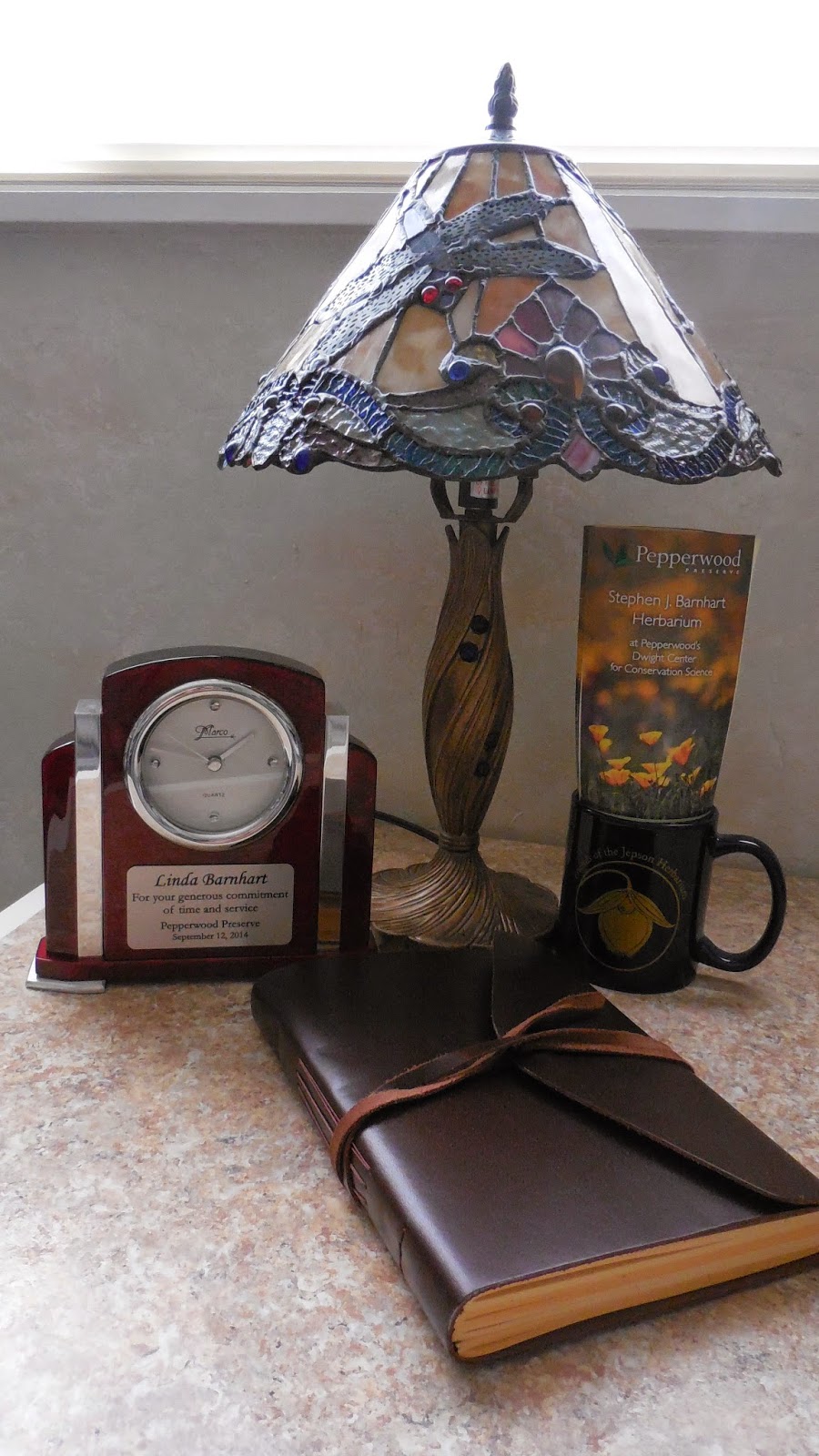
In 2007 I was one of the original Pepperwood Stewards.  When the Bio 85.1 and Bio 85.2 courses were developed, I took both semesters and also received the UC California Naturalist Certificate in spring 2010. Our class was the first to receive this certification in California, since Pepperwood was the pilot California Naturalist program. As one of the original stewards, I have not lost an ounce of enthusiasm for Pepperwood. “Lead by example” someone once said and I try to help others see the importance of tending to our land and to catch the excitement of bringing science and solutions to our community. I was recently honored with the 2014 Pepperwood Service Awards. 

Tell us a little bit about your background and how you became interested in Pepperwood. What keeps you motivated?
I am now retired as the Operations Coordinator at the Small Business Development Center. I have had a passion for the out-of-doors as long as I can remember. With my collection of books in my back pack, I taught myself many things about nature when we did our family camping trips many years ago.  Self-motivation today is maintained by involvement wherever I feel I can be of service at the preserve. I as well will attend the Naturalist Conference in Pacific Grove later this month. It is important to continue to learn, take classes and inspire others to do the same. Motivating others motivates me!!!  

“Find your voice then help others to find theirs” 
From Steven Covey’s, 8th Habit  

What projects have you worked on?
Throughout my years at Pepperwood I have worked on many projects and helped in numerous ways wherever needed.  Some of my most delightful memories were helping Margaret Boeger with the very first children’s educational programs offered at Pepperwood. I developed a photographic ID guide of the Pepperwood wildflowers that Margaret and the Steward Assistants could use in these classes. Currently, I am a greeter at the sign-in table at various public events. I also assist with public hikes, proctor educational classes and work with the herbarium, collecting, labeling, filing and freezing. My photos of Pepperwood wildflowers are an ongoing project that has continued since my early years of being a steward. These photos have been used for the Spring Wildflower Festival and other purposes. 

What are three words that describe Pepperwood to you?
Tranquility, amazing, delightful 

What does your experience at Pepperwood mean to you?
For me, to see the vision of Pepperwood grow from the idea stage to a place to learn about nature is most rewarding.  This dream has now been adopted by others as well.   

If I were painting a landscape of Pepperwood, it would include the following so others would be inspired to catch the vision…

A Horizon – it would remind others of the incredible possibilities for the future.
The Sun – to give them warmth and hope.
Mountains – to represent the challenges ahead.
Birds – to inspire them to soar like eagles.
Flowers – to remind them to enjoy the journey.
A Path – to offer direction and security.
Myself – to demonstrate my commitment to the dream and to them.
Them – to show where they fit in and to communicate my belief in them.

Share the Dream from the book “Your Road Map for Success”.
I am willing to share my dream by helping others to see the need of tending our land and providing educational programs for both children and adults as well as science solutions for our very own community. 

What’s the most surprising thing you've learned or seen at Pepperwood?
Bio 85.1 and Bio 85.2 were amazing!!! I attended these classes at the SRJC and then once a week we would come to Pepperwood and apply what we had learned. There were different instructors weekly on different topics. I learned about so many things such as the value of the Grinnell Method in keeping a field journal, geology, soils, climate, water, plants, forests and woodlands, wildlife, energy and global environmental challenges. These weeks were the most exciting time I have ever had out in nature. What I learned provided the most surprising information. I was inspired and just wanted to let everyone know about Pepperwood and this amazing resource in Sonoma County.

What’s the one thing you’d want to share with someone who is thinking about volunteering?
Move forward in your quest to learn!  Do some volunteer work in the field, but don’t stop there. Take Bio 85.1 and 85.2. You will never ever regret the time you spend even if you already have degrees. A refresher course would not hurt and would help you to see Pepperwood through a new set of eyes. Then, teach others and inspire others to find their voice in the world of conservation. You may not be a professional, but you can inspire and get others excited about how they can help conserve nature in their everyday life and in their own backyard!

What do you like to do in your spare time?
In my spare time, I love to hike and camp with my husband and share nature with our 6 grandchildren.  I took one of John Muir Law’s journaling classes and then obtained copies of his Sierra Field Guide for 2 of my grandchildren who live in the Sierras.  In the photo you see me providing a lesson from this book that they each have.  Sharing Pepperwood with our granddaughters from Gig Harbor, Washington, including looking at the education rooms and going on the Douglas-fir trail, was great fun this summer. Teaching about conservation and science and how to be good stewards of the land is so important in the education of our next generation.  Our other two grandsons are now in college.

I am a Pepperwood member and also a member of the Yosemite Association, the Yellowstone Association, National Wildlife Federation, Audubon Society, California Native Plant Society, the Nature Conservancy, Sonoma Land Trust, the Laguna Foundation and the Friends of the Jepson Herbarium.

 ---
 Interested in volunteering? Check our website for more information.

Tuesday, September 23, 2014

Pepperwood Rocks!

By Judith Fenley, Pepperwood Member

Pepperwood Rocks: Indeed it is so!  Reflections on a rockin’ day, at Pepperwood Preserve, Saturday, September 6, 2014 

A glimpse of how to see with a geologist’s eye opened up the Pepperwood landscape in new ways.

We traveled far enough back in geological time to see an image of earth with only one land mass.  An animated time warp, on-screen, journeyed through the continental shift to the “Super Continent, Pangaea” to “Laurasia” and on to our current, yet ever-shifting global territory map.

Variations of the Teutonic plates -- the divergent plate boundary, the convergent plate boundary, and the transform plate boundary, are all present in California, making our state an exceptional geological study area. 

Our Mayacama region is resplendent with rocks of all types as well.  Before our hike, we partook of a visual and tactile rock feast.  No, we did not eat any rocks.  Fondling variations of each type of rock, readied us to head out of doors.

Identification challenged everyone.  Even our instructor admitted most all rocks looked alike, once covered with lichen and earth debris.  A handy geo-hammer cracked through to a clean surface, as needed.  Igneous rock like basalt, tuff, and granite, sedimentary rock of chert, sandstone, and shale, metamorphic rock of greenschist, and serpentine all made their appearance.  It was a rocking-out afternoon! 


No fault of the rocks, fault lines made their debut as well.  A flat area with a sudden rise demonstrated an earthquake upheaval (not of our recent jolt).  Riparian areas gave evidence of a fault line that allowed underground moisture to nourish maple and willow trees.   

Our rolling California hills tell their geological story to a trained professional. Rebecca Perlroth, our geology instructor and guide, was true to her promise, covering an introductory semester of geology in a two-hour lecture.  A gifted and captivating Instructor, her power point presentation, as well as the guided hike, tested our assimilation of her material, and held us captive. 

Our geologist-eye view sparked my deeper curiosity.  If it intrigues you as well, I suggest you attend next year’s repeat of this offering, along with me. 

We rocked out!  Here are some pictures to prove it.


Wednesday, September 10, 2014

Bird Language and Animal Tracking with Meghan Walla Murphy

Responses by Meghan Walla Murphy, Educator, Wildlife Tracker, Ecologist, & Writer

How did you get into bird language and tracking?  
I have been formally involved in ecology, conservation and environmental public outreach since my studies at UC Santa Cruz in 1993, but my passion for the land and its natural history began long before that. When growing up my childhood gang took trails that wandered over fences, along tree branches, and through vacant lots. We rarely used roads or sidewalks, preferring the secretive places in between. Now as I dedicate my work to wildlife corridors and wilderness linkages, I see that these interstitial spaces - these kid spaces between human structures - connected the wild places of our neighborhood to the wild things within us. 

Are there common techniques used by trackers in Northern California? How much of what you teach can be applied outside of California? 
My tracking journey has taken me all over the country and the globe. From 2005-2010  I dedicated my time to tracking and writing. During these years, I drove around the country in my truck and would pull into a town and find out where the trackers and old timers were. It was via these trips that I learned many different tracking techniques that are not unique to Northern California or even just California, but really common everywhere I went. I also traveled to Mexico and Brazil to learn from people living down there, and I lived in South Africa two different times specifically for the purpose of learning to track. I feel that tracking techniques are wide ranging and can be used in many different areas. It is one's sense of place or ecological knowledge of an area that creates specificities in tracking. The same species often has different behaviors in a different habitat, and that is where knowledge of place is essential in differentiating the track and sign one is seeing. 

I see you teach tracking classes just for women. Can you share a little more about this? 
Most of my teachers and mentors have been men, for whom I am unbelievably thankful for. But in 2006 I had the opportunity to track with a group of women at Women's Tracking Gathering in the Berkshires, hosted by Lorene Wapotich. It was then that I had insight to a different kind of tracking experience. When women track they tend to be more collaborative and less competitive in their analysis of a track. The answer becomes less important and the questions and story become the focus. This is not to say that I have not tracked with men who will question the same, but generally, especially when the group is predominantly men, which is often, the intention of tracking changes. I have deep appreciation for my experience with tracking with both men and women, as they have developed different sides of my own tracking knowledge.  Lastly, the tracking world is largely dominated by men, perhaps a result from the hunting world. (And I do believe this imbalance is shifting in the past few years.) Given this imbalance, women can be intimidated to ask questions or speak their thoughts, or explore freely. An all women tracking conference gives women the freedom to explore tracking and then have more confidence when they are in co-ed classes. 

I am working on running a co-ed tracking conference in the next few years. 

What skills can participants expect to walk away with from your bird language and tracking class? 

Participants will learn to recognize  patterns of basic bird behavior which reveal clues of the relationships animals have with each other and the landscape. They will learn to recognize baseline and alarm calls. In addition participants will learn basic track and sign patterns, such as discerning the difference between feline, wild canine, domestic dog, and other animal families. Participants will also learn to tune into their senses, giving them greater awareness of their surroundings both at Pepperwood and in their own backyard. In addition we will discuss perceptions that tracking can open up in individuals who develop a regular tracking practice. 

Can you share one of your most memorable tracking experiences? 

There are many many stories of the land and animals that I can share, but the one that is coming to mind know, is from an experience of tracking in the chaparral of southern California. Not long before this moment I had learned that coyotes often use their voices, yips, yowls, howls to create terror in their prey so that they will run from the sound, but the sound is so pervasive, the prey cannot discern where the sound is coming from. This disorientation gives the coyotes an advantage to capturing their quarry. Well, on this day I had been on a coyote trail that snaked down low and in and out of ceanothus thickets. Most of the hour I was on my hands and knees moving like a coyote on these single track trails. At one point I decided to sit still and watch and listen. Perhaps 20 minutes into this sit, the coyotes began to yip and yowl. At first it was just a few bursts here and there, and then the cacophony escalated. Though I could not discern which direction the howls were coming from I was surrounded by a swirling vortex of sound. Intellectually I knew the coyotes were not hunting me, but different prey in my vicinity, but instinctually, my animal body was telling me to get the hell out of there, yet I had no idea which way to go. My impulse was to move whichever way to get out of the noise. In that moment I was in the eye and body of the prey animal and completely understood how rabbits were often lured into the trap of the coyotes' song. 

Have you ever been tracking an animal and surprised it? 

Yes, there have been several instances where I have come upon an animal and surprised it. Sometimes it is because I am intentionally searching for that animal and sometimes it is because we happen to be moving in the same habitat doing our own thing and bump into each other. Regardless of my intention, the times in which I come upon animals without them knowing that I am there first are completely dependent on my own mental state. If I am busy in my head and not in my body, that mind chatter usually alerts animals of my presence much sooner than my physical presence. In school we are traditionally trained that we have 5 senses. But as I continue my journey in tracking I feel certain that our sensory awaness extends far beyond these 5 common senses. And of course that does not include the multitude of ways that animals perceive the world. It is these additional senses that are often the cues and alarms that alert the animals to my presence. If my mind is louder than usually the animals hear me, even if my movements are quiet. 

Anything else you would like to add? 

While I deeply believe that tracking is a practical applied skill, tracking has also become a paradigm through which I view the world. Tracking extends far beyond the realms of only foot prints and sign. People track everyday. They chart the weather, water flow, seasonal plant growth.  Teachers track their students. Parents track their child's development. Via tracking people can drop into a sensory awareness that can inform them of the patterns occurring around them each day whether they are in the wilderness, at home or in the city.

---

Meghan Walla Murphy is leading Pepperwood's 2015 Fall Retreat! 

Bird Language and Animal Tracking: 

Reading the Signs of a Landscape
Saturday, November 7 at 9am through
Sunday, November 8, 2015, at 3pm

Click here for tickets or more info. 

For more information about more of Meghan's upcoming classes, visit her website here.